
Cover image from zerochan
The 27 True Runes
In the beginning, there was “Darkness.”
“Darkness” lived for eons in a rift in time.
Suffering in solitude for so long,
“Darkness” finally dropped a “Tear”.
Two brothers were born of “Tear”.
“Sword” and “Shield”.
“Sword” said he could cut anything to pieces.
“Shield” swore he could protect anything.
And so, the two went to battle.
The battle lasted seven days and seven nights.
“Sword” cut apart “Shield”, and
“Shield” broke “Sword” into pieces.
Fragments of “Sword” fell and became the sky.
Fragments of “Shield” fell and became the earth.
Sparks form the battle became the starts.
The 27 jewels that adorned “Sword” and “Shield”
became the “27 True Runes”, and
the World went into motion.
This fragment is the history of the creation of the 27 True Runes, mystical crystals that are very important in the story of Suikoden, a franchise that has been developing since 1995. Suikoden is a series of role-playing games created by Yoshitaka Murayama and loosely based on the classical Chinese novel “Shun Hu Zhuan (Water Margin)” from which it gets the basis for creating the concept of the “108 Starts of Destiny”. Essentially, each Suikoden follows the plot of a coup d’etat by a corrupt power holder(s) and a protagonist who is exiled from his/her home. The mystical ingredient, as stated before, is a series of crystals called True Runes that are the equivalents of the gods in the world of this game. As a general rule, the main character is destined to acquire one of these and struggle its power at the same time that using it to bring peace to the land alongside his/her friends.
The runes have the characteristic of living within a crystal until they meet a bearer and, achieving this, they take the form of a tattoo with a design that has a close relationship not only with their name but also with their powers and the objective they have in the world. All this makes the idea of doing an analysis of the visual representations used for each True Rune interesting. So that is why this post will unravel all the secrets behind the design, not of the 27, but of the ones that are at the center of Suikoden’s main series. This means, the True Runes possessed by the protagonists of Suikoden I to V. So, why not start at once?!
SUIKODEN I: LIFE AND DEATH
“Soul Eater” is the name of the True Rune of Suikoden I and its current owner is Tir McDohl. It grants powers over the energies of Life and Death and, like the other True Runes, bestow ageless immortality. However, with the name one can guess that the price for having it is high since it has a curse: this rune seeks people close to its bearer in order to eat their souls.
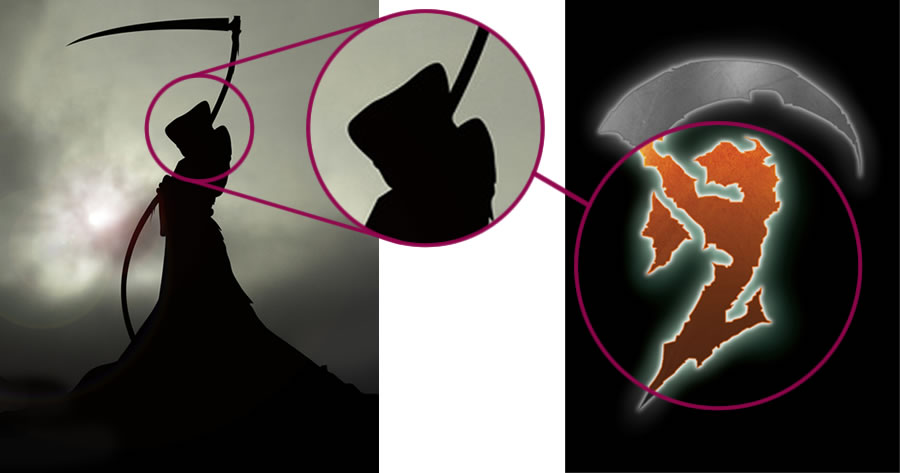
The shape of this True Rune resembles the “Grim Reaper”, the personification of Death in some mythologies. The concept of “Grim Reaper” is believed to have appeared in Europe during the 15th century when the worst pandemic in the world, the Black Death, was occurring. Europe suffered many human losses, making death something that Europeans constantly had in mind and provoking them to create an image to represent it. The “Grim Reaper” is sometimes seen as an entity that causes the death of its victims by taking their souls, but other times it’s seen only as the soul collector of already dead people. Whatever the case, the relation between the “Grim Reaper” and souls makes him the ideal source of inspiration to create the “Soul Eater” True Rune.
In the design of this rune, it’s possible to see the scythe as a central component. The scythe is an agricultural tool that used to harvest crops that are ready to be plucked from the earth, so in a way, this is what happens when humans die: they are plucked from this earth. The above explains why the “Grim Reaper” is always seen with a scythe and, since it’s a very representative item in this personification, it was essential to apply it in the “Soul Eater” model.

(Images from FAVPNG and DeviantArt)
However, the scythe is not alone, it is accompanied by another drawing. The latter is probably derived from the robe that hides the skeletal body of Death, and whose concept comes from the clothing worn by religious figures wore when conducting funerary service. This black robe has a hood so, when looking at the top of the “Grim Reaper” when in profile, the silhouette that forms this hood is very similar to the one that accompanies the scythe of the “Soul Eater” True Rune.
(Grim Reaper image form Singularity Weblog)
SUIKODEN II: THE INITIAL CHAOS OF BIRTH
The “Rune of the Beginning” is the True Rune that represents the “initial chaos of birth” and is generally encountered as two separated runes: the “Bright Shield” and the “Black Sword”. This True Rune appears in Suikoden II, where the main character, Riou, obtains it if the alternate ending is chosen. It’s said that this rune grants its owner the power to “judge war”, and it’s precisely this concept that was chosen to be one of the sources of inspiration for the design of this rune.
First of all, the most obvious figure that composes the True Rune being talked about is the sword. This makes sense since, as said before, the “Black Sword” constitutes the “Rune of the Beginning”. The sword was an effective military weapon before World War I, which means that it was a great choice of armament in the 14th century, the time when the novel “Shui Hu Zhuan” was written. Then, this may be the reason behind the rune that “judge war” contains a sword. Furthermore, this weapon is mentioned a lot in Japanese history.

(Images from Andracor, Pinterest and Fandom)
To continue, the pommel of the sword is like a circle with rays around it. This abstraction could have derived from the “Rising Sun Flag”, which is a flag that was originally used by feudal warlords in Japan during the Edo period and that was adopted by different forces in Japan in the subsequent years. This same resource is taken up in the “Bright Shield” but with more rays to cover the entire image of the shield.

(The “Bright Shield Rune” from Pinterest)
Let’s finish this block with another possible interpretation of this True Rune that involves a fragment of the pommel of the sword and the circle at the back part of the rune. This combination can be seen as an abstraction of a dawn or a sunrise, ideas suggesting rebirth, awakening, the coming of light or, taking a word from the name of the True Rune, a new “Beginning”.

(Sunrise image from El Androide Libre)
SUIKODEN III: NOT ONE BUT THREE HEROES!
Suikoden III is the only game in the saga where the story is presented through the “Trinity Sight System”, rather than having only one “hero”, the plot is explored though three different viewpoints, reason why it’s needed to talk about three True Runes: Fire, Water and Lightning.
- THE WATER TRUE RUNE
It remains in the possession of either Chris Lightfellow or Hugo, depending on whom the player names as the new Flame Champion.
Since the most correct thing is to take the name as inspiration to create its representation, the design takes the ripples that form in the water when there is a physical interaction of it with another object. For example, when a stone or a drop falls into a body of water. The next thing to do is to create the abstraction of this phenomenon. In fact, the normal model of the “Water Rune” comes from how it views, from the front, a drop of water falling and provoking ripples, while that of the “True Water Rune” is just the ripples seen from above.

(Photo by Terry Vlisidis on Unsplash and Rune from Fandom)

(Photo by Linus Nylund on Unsplash and True Rune from Fandom)
- THE TRUE LIGHTNING RUNE
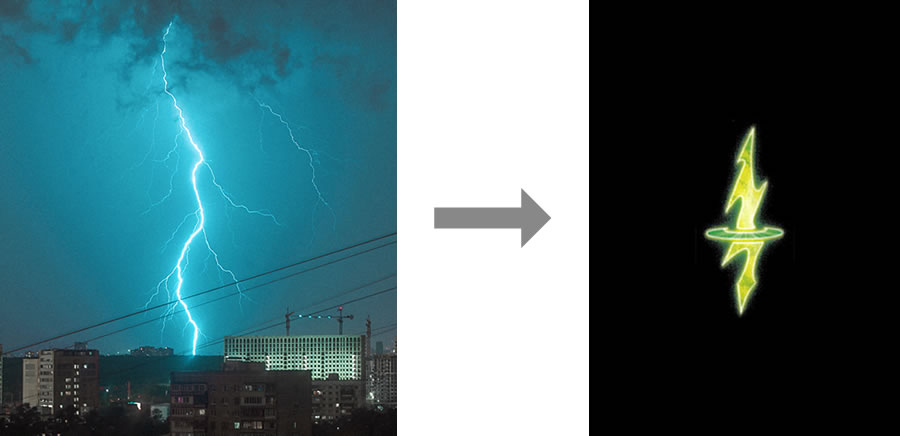
Depending on whom the player names as the new Flame Champion, the owner of the “True Lightning Rune” can be Geddoe or Hugo. It’s associated with the element of lighting and this is reflected not only in the name but also in its shape.
The “True Lightning Rune” is an abstraction of a lightning spark in view of the fact that it has a central circle from which several thunders are born that go to all directions. To give the feeling of more power, the difference between the “Lightning Rune” and the “True Lightning Rune” is the number of bolts.
(Photo by Liliya Grek on Unsplash and Rune from Fandom)

(True Rune image from Fandom)
- THE TRUE FIRE RUNE
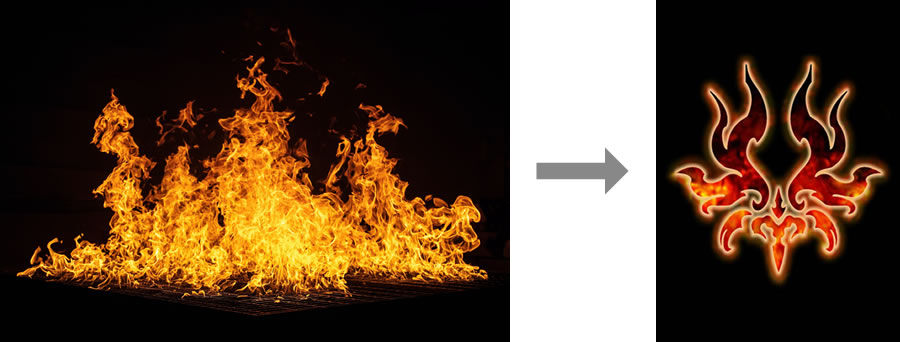
The “True Fire Rune” represents, as the name says it, the power of fire. This rune goes berserk after the legendary Flame Champion removed it from his body using an ancient Sindar secret. This causes a fire storm that lasts 10 days and 10 nights and is therefore sealed after wiping out many armies. After a time, Hugo decided to bear this Rune to protect his home. However, in Suikoden III the player can decide between Hugo, Chris and Geddoe to be the new Flame Champion.
Like the two previous, the fire is both in the name and in the design. In this case, to show a power difference between the “Fire Rune” and the “True Fire Rune”, the former is inspired by a small flame and the True Rune by a blaze, which is a fire producing many flames.

(Photo by Amador Loureiro on Unsplash and Rune from Fandom)
(Photo by Ricardo Gomez Angel on Unsplash and the True Rune from Fandom)
SUIKODEN IV: ATONEMENT AND FORGIVENESS
The “Rune of Punishment” represents atonement and forgiveness and is always borne in the host’s left hand. This rune has a tremendous offensive capability, but at the cost of the bearer’s life force. Its first appearance was in Suikoden IV, in which the protagonist is Razro, who is the current owner.
Some sources mentioned the pattern of this rune comes from the tattoos that were generally found on the arms of ancient Japanese executioners. The foregoing probably has a relation with the Burakumin, the group the executioners belonged to, and the story behind them.
Burakumin, meaning “hamlet people”, dates back to the feudal era. These were people who performed jobs that were considered “unclean” or morbid, such as executioners, undertakers, slaughterhouse workers, butchers, or tanners. Because of this, they were victims of severe discrimination in Japanese society. Despite in the Meiji Restoration the Government decree granted equal status to these outcasts, the descendants of Burakumin continued to face stigma and discrimination in Japan. To combat this situation, in 1922 a Burakumin rights group called the National Levelers Association was founded. Nevertheless, due to World War II, the movement gained strength until 1946 under the name of the National Committee for Buraku Liberation, which later evolved into the Buraku Liberation League (BLL), the current name. To represent this league, a flag was made, which is what served as inspiration to create the “Rune of Punishment” since the executioner, the person who “punishes”, has a close relation with the Burakumin.
The symbol on the BLL flag is a circle with thorns on both on the inside and outside it. The “Rune of Punishment” features these same thorns, but in a spiral. This probably to give the idea of a “more painful punishment”.

(Flag from Wikipedia Commons and True Rune from Fandom)
SUIKODEN V: LET’S COMBINE RUNES!
Suikoden V is the game where the “Sun Rune” makes its appearance as the True Rune that governs over the great power of the sun. This is the only rune which design involves the shape of two others: the “Moon Rune” and the “Beginning Rune”. Firstly, the “Moon Rune” is in the center of the “Sun Rune” and this may be in view of the fact that the sun and the moon are considered to be interlinked, since they make the day and night look complete.

(Images from Fandom)
The “Rune of the Beginning” is also part of the “Sun Rune”. First thing, one has to rotate it 180° to be able to identify that the crescent on the back of both runes is almost the same.

Next, one has to focus the attention on the sword in the “Rune of the Beginning” and the middle part of the “Sun Rune”. The similarities are in how the upper part of both runes are like a wavy line and in how the lower point ends in a hook shape.

Just as final a final touch, the idea of flames forming the “Sun Rune” reminds the sun.
Thanks to this post, one can realize that video games contain many visual elements and that they should be well-thought-out how to design them. And it’s also clear that these are not only interfaces, characters and icons. There is a myriad of components that must be designed to achieve not only a good understanding of the mechanics of the game, but also of the story. For example, in the case of Suikoden, the runes are an important part of the story, making necessary to put extra effort into their design.
Well, this “mystical” analysis is over, and I hope you liked it. Let me know your opinion in the comments. See you in my next post!
BIBLIOGRAPHY
- “Buraku Liberation League,” Wikipedia. 13-Dec-2020 [Online]. Available: https://en.wikipedia.org/w/index.php?title=Buraku_Liberation_League&oldid=993954738. [Accessed: 25-Feb-2021]
- “Dawn.” [Online]. Available: http://umich.edu/~umfandsf/symbolismproject/symbolism.html/D/dawn.html. [Accessed: 27-Feb-2021]
- “Fire vs Blaze – What’s the difference?,” WikiDiff, 05-Sep-2015. [Online]. Available: //wikidiff.com/fire/blaze. [Accessed: 13-Mar-2021]
- “Grim Reaper (folklore),” Villains Wiki. [Online]. Available: https://villains.fandom.com/wiki/Grim_Reaper_(folklore). [Accessed: 10-Mar-2021]
- J. Gates, “Who Are the Burakumin, Japan’s ‘Untouchables’?,” Culture Trip. [Online]. Available: https://theculturetrip.com/asia/japan/articles/a-look-at-the-burakumin-japans-untouchables/. [Accessed: 25-Feb-2021]
- “Japan’s hidden caste of untouchables,” BBC News, 23-Oct-2015 [Online]. Available: https://www.bbc.com/news/world-asia-34615972. [Accessed: 25-Feb-2021]
- “Rune of Punishment,” Suikoden Wikia. [Online]. Available: https://suikoden.fandom.com/wiki/Rune_of_Punishment. [Accessed: 25-Feb-2021]
- “Rune of the Beginning,” Suikoden Wikia. [Online]. Available: https://suikoden.fandom.com/wiki/Rune_of_the_Beginning. [Accessed: 14-Mar-2021]
- “Suikoden,” Wikipedia. 29-Jan-2021 [Online]. Available: https://en.wikipedia.org/w/index.php?title=Suikoden&oldid=1003618968. [Accessed: 02-Mar-2021]
- “Suikoden III,” Wikipedia. 01-Mar-2021 [Online]. Available: https://en.wikipedia.org/w/index.php?title=Suikoden_III&oldid=1009556384. [Accessed: 04-Mar-2021]
- “Sun Rune,” Suikoden Wikia. [Online]. Available: https://suikoden.fandom.com/wiki/Sun_Rune. [Accessed: 06-Mar-2021]
- “Sword.” [Online]. Available: http://umich.edu/~umfandsf/symbolismproject/symbolism.html/S/sword.html. [Accessed: 27-Feb-2021]
- “The 27 True Runes | Suikoden Wikia | Fandom.” [Online]. Available: https://suikoden.fandom.com/wiki/The_27_True_Runes. [Accessed: 03-Mar-2021]
- “The Sun and Moon – Significance in Art and Design.” [Online]. Available: https://www.lafuente.com/Blog/The-Sun-and-Moon-Significance-in-Art-and-Design/. [Accessed: 13-Mar-2021]
- “The Sword in Warfare | History Today.” [Online]. Available: https://www.historytoday.com/archive/sword-warfare. [Accessed: 27-Feb-2021]
- “True Fire Rune,” Suikoden Wikia. [Online]. Available: https://suikoden.fandom.com/wiki/True_Fire_Rune. [Accessed: 11-Mar-2021]
- “True Lightning Rune,” Suikoden Wikia. [Online]. Available: https://suikoden.fandom.com/wiki/True_Lightning_Rune. [Accessed: 04-Mar-2021]
- “True Water Rune,” Suikoden Wikia. [Online]. Available: https://suikoden.fandom.com/wiki/True_Water_Rune. [Accessed: 04-Mar-2021]
- “Water Ripple: What Causes Ripples In Water?,” Science ABC, 07-Feb-2020. [Online]. Available: https://www.scienceabc.com/eyeopeners/what-causes-ripples-in-water.html. [Accessed: 04-Mar-2021]
- “Where Does the Concept of a ‘Grim Reaper’ Come From?,” Encyclopedia Britannica. [Online]. Available: https://www.britannica.com/story/where-does-the-concept-of-a-grim-reaper-come-from. [Accessed: 13-Mar-2021]

 The Picky Champy
Very nice article.
I never noticed the design very similar to the blue moon rune in the center of the sun rune.
For my taste, the sun rune always had a bit too much going on. Compared to the other rune designs of the series, it feels overdesignef. Your analysis supports this by showing all the different elements going on.
LikeLike
Thanks!
Yes, I agree with your comment on the Sun Rune. Thanks to this analysis I observed at all the runes, and I feel that this Rune has many elements compared to the others. One would expect a more abstract form or a combination of the two that make it: the Dawn and the Twilight Rune.
I hope to find the true explanation behind the design of this rune one day 😛
LikeLike